Developer Relations for Startups: How to Do DevRel Without a DevRel Hire
What developer relations means at a startup, the ship-announce-document-listen loop, a two-hour weekly cadence, what to skip, and when to hire a developer advocate.
The short answer
At a startup, DevRel is making sure every release reaches the developers who'd care: announce it where they are, document it before they ask, and listen to what comes back. Give it an owner and a fixed weekly slot, skip events and ambassador programs early, and hire a developer advocate to scale a loop that already works.
Key takeaways
- Most of early DevRel is habits, not headcount.
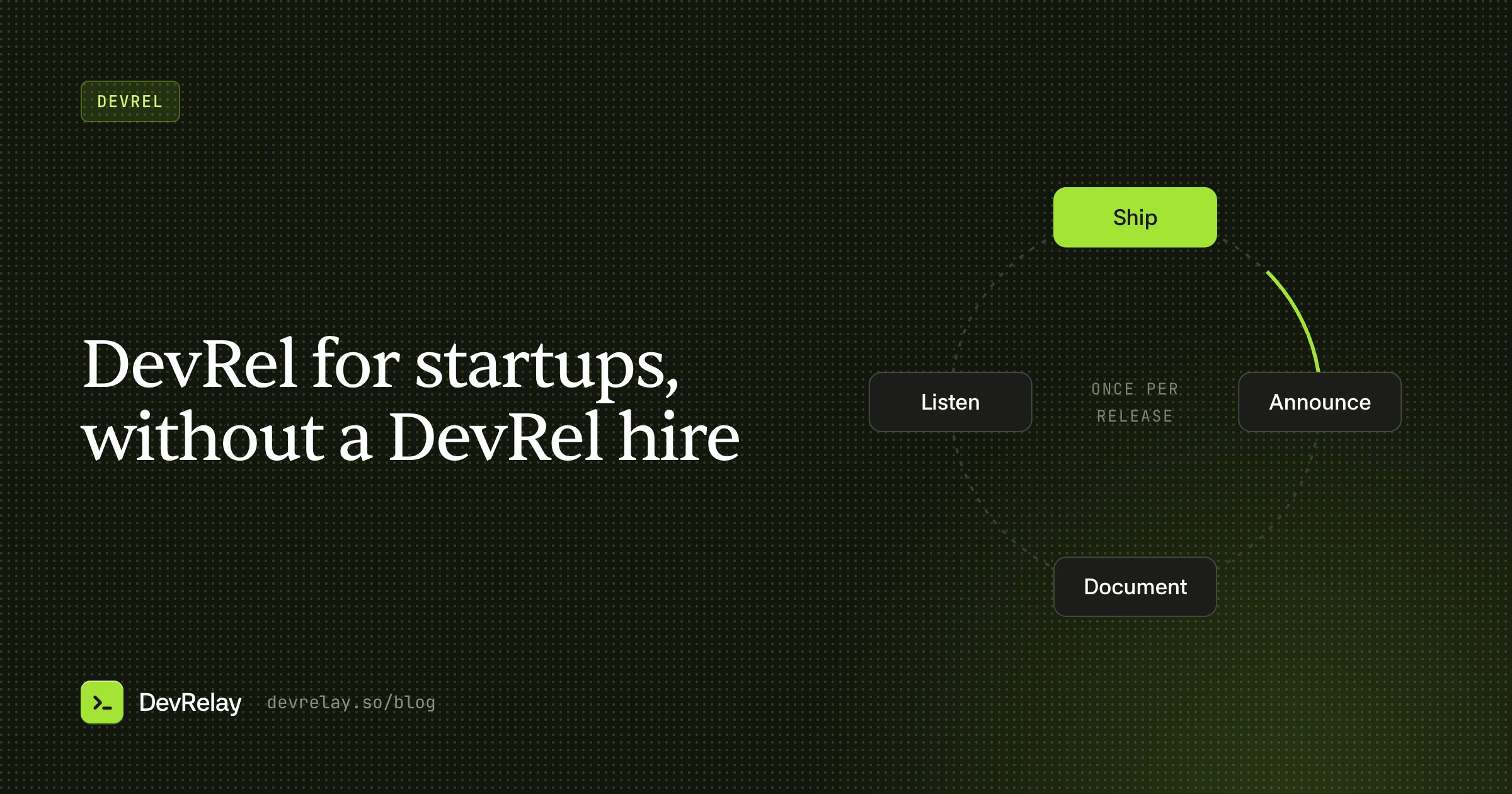
- Run one loop per release: ship, announce, document, listen.
- Announce the changes that matter; let the changelog carry the rest.
- Hire to scale a working loop, not to build one from nothing.
At most early-stage developer tool companies, developer relations is nobody's job, so it's everybody's job, so nothing happens. The founders are selling, the engineers are shipping, and the release that took a month goes out with a one-line tag and no announcement. Six months later the docs describe a product that no longer exists, and someone suggests it might be time to hire a developer advocate.
You might need that hire eventually. But most of what a startup needs from DevRel is a set of habits, not a headcount. This guide covers what developer relations actually means at a startup, the minimum loop that works without a dedicated person, a weekly cadence you can run in a couple of hours, and how to tell when it's time to hire.
What DevRel means at a startup
At a large company, developer relations covers a lot: conference talks, community programs, ambassador schemes, sample apps, partner integrations, developer surveys, and a team to run each of them.
At a startup, strip it back to the part that compounds. DevRel is making sure that every time you ship something, the developers who'd care find out, understand it and can use it. That's it. Everything else (events, community, swag) is a multiplier on that, and a multiplier on zero is zero.
That definition gives you three jobs:
- Tell people what shipped, where they already are.
- Explain it in docs and examples that match the code.
- Listen to what developers say back, and feed it to the product.
The DevRel loop
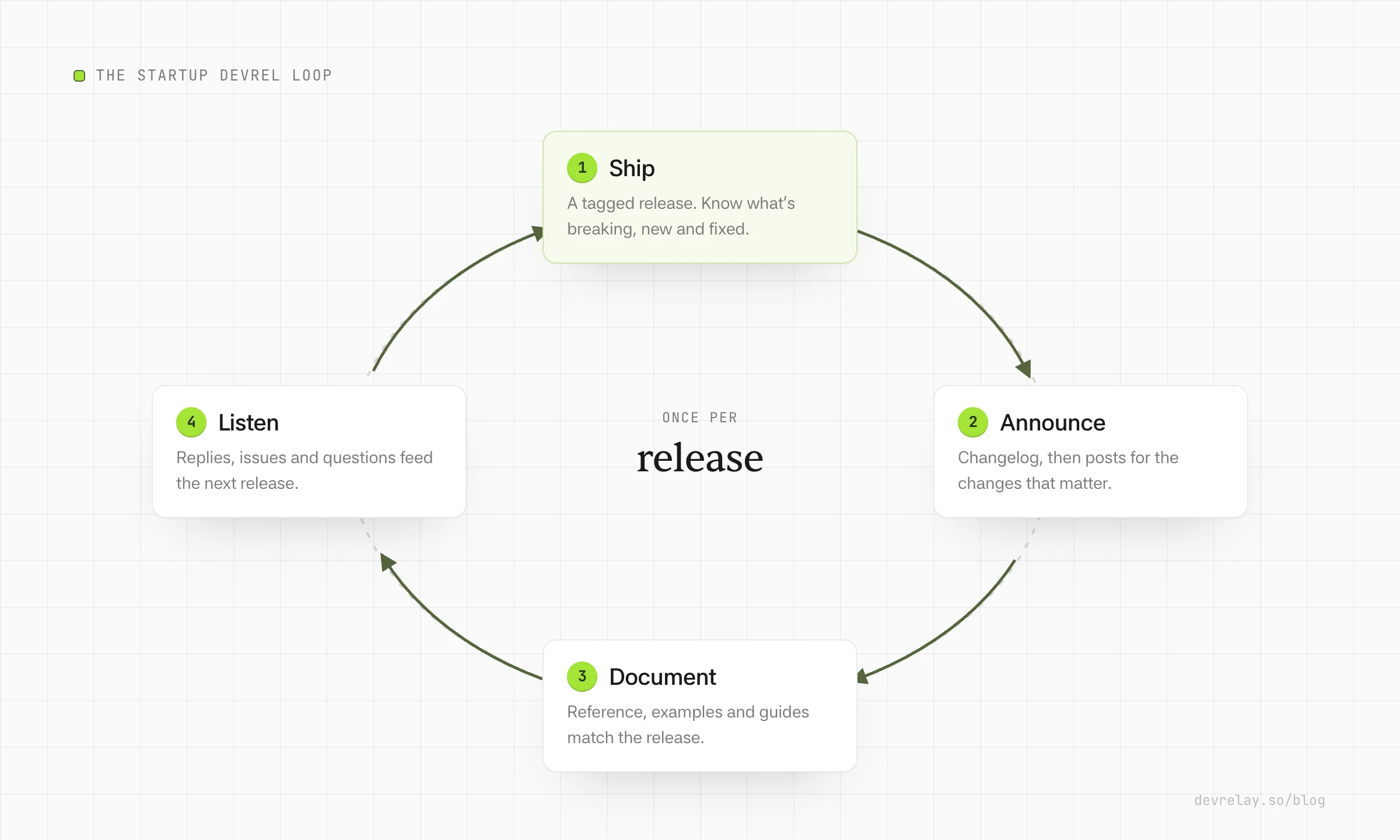
Those jobs fit into one loop that runs every time you release:
1. Ship, and know what shipped
The loop starts with a release, not a merge. You need to know which changes actually reached users in this version, grouped into what's breaking, what's new and what's fixed. That's your changelog entry, and it's the raw material for everything else in the loop.
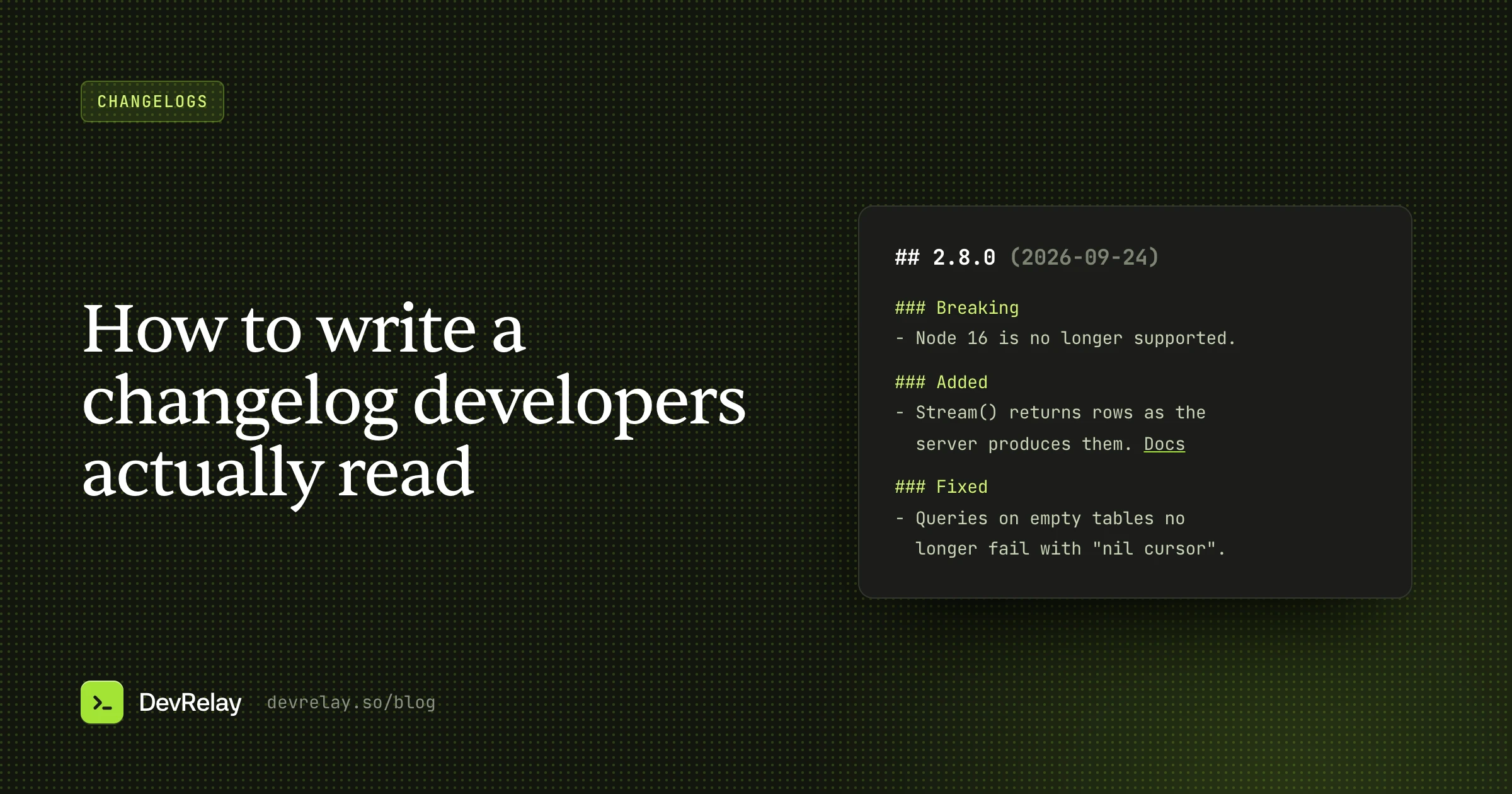
If assembling that list takes an afternoon of reading git log, fix that first. Commit conventions and a changelog line in each pull request make it a five-minute job. We cover the process in how to write a changelog developers actually read and the tooling in how to automate your changelog from GitHub.
2. Announce, on the channels developers read
Not every change deserves an announcement. A useful rule of thumb:
| Change | Where it goes |
|---|---|
| A capability users will want to try | Changelog, release notes, an X post or thread, a LinkedIn post, maybe a tutorial |
| A notable feature or improvement | Changelog, an X post |
| A bug fix users hit | Changelog, and an X post if many people reported it |
| A breaking change | Changelog first, a heads-up post, a migration guide |
| An internal refactor, dependency bump or typo fix | Nowhere |
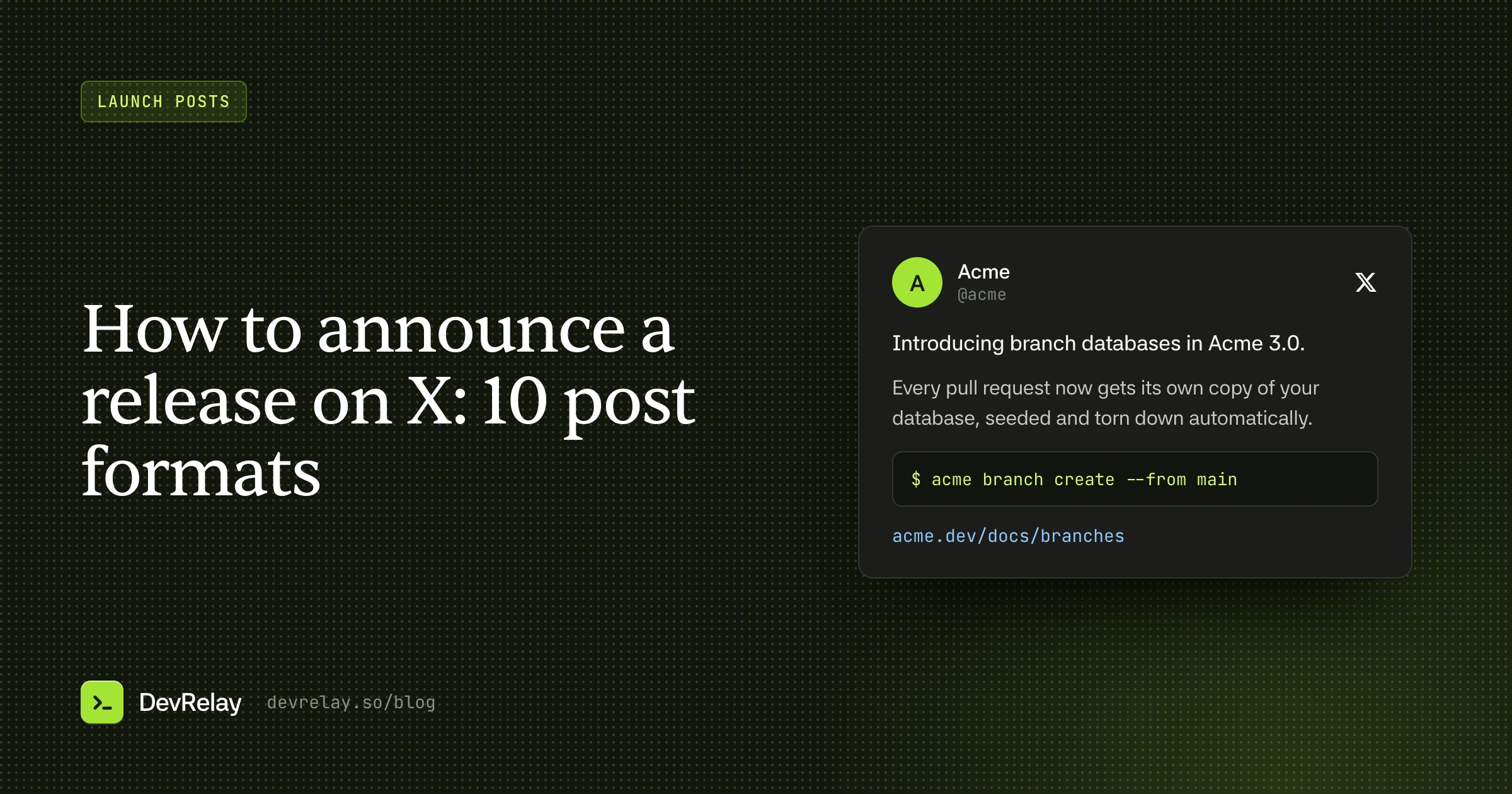
Most startups under-announce big changes and over-announce small ones. Post about the thing that matters, with a code snippet and a link, and let the changelog handle the rest. For post structures that work, see how to announce a release on X.
3. Document, before someone asks
A feature that isn't documented doesn't exist for anyone who wasn't in the pull request. For each release, check:
- Does every new option, method or endpoint appear in the reference docs?
- Do existing guides still work, or do their examples use something you just changed?
- Is there a short example for the headline feature, ideally one you can link from the announcement?
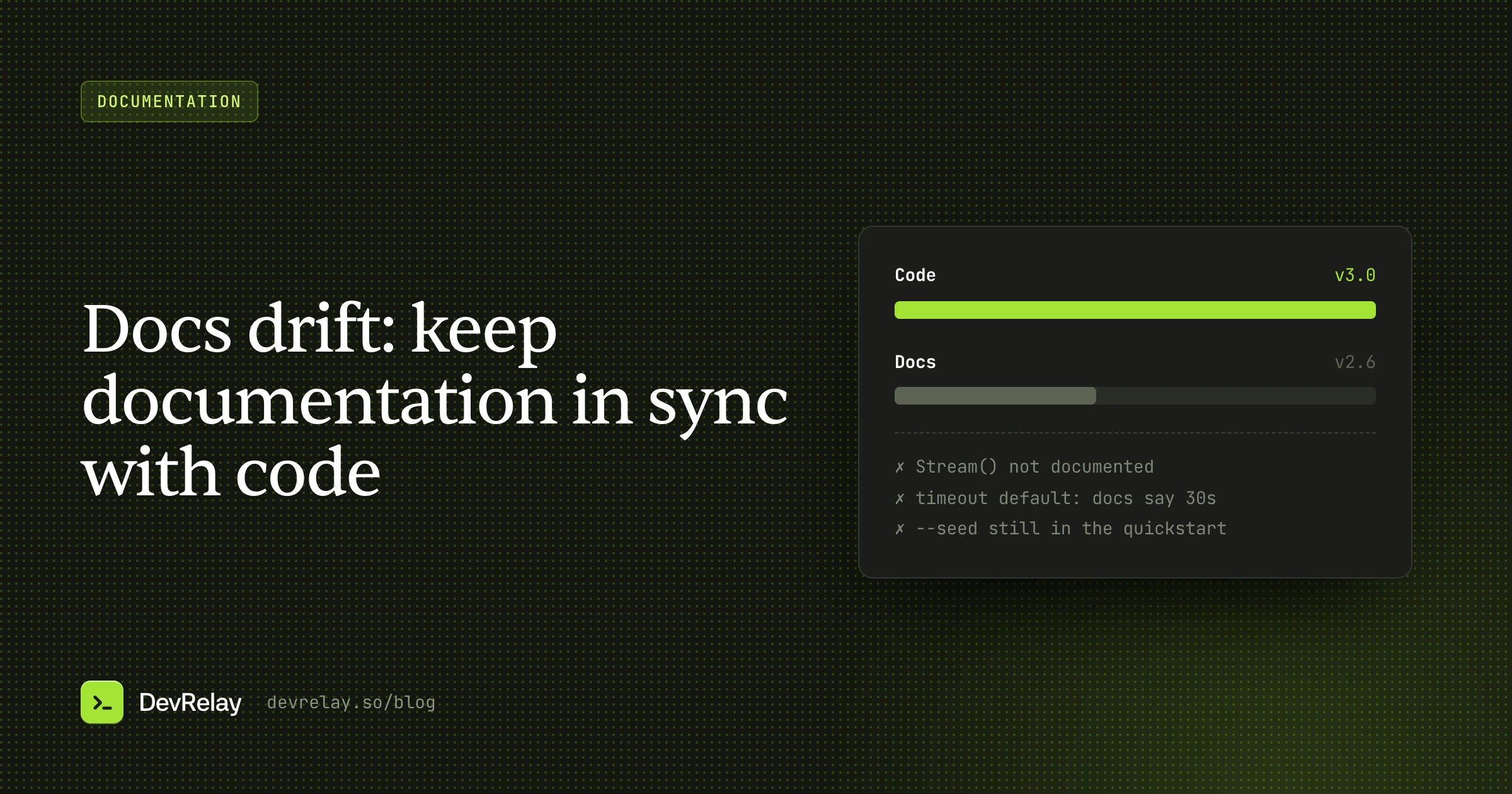
This is where most small teams fall behind, and once docs drift they rarely catch up. We cover how to stop that in docs drift: how to keep documentation in sync with your code.
4. Listen, and close the loop
After each release, spend fifteen minutes looking at what came back:
- Replies and quote posts on the announcement.
- New GitHub issues and discussions, especially ones that mention the new feature.
- Questions in your Discord, Slack community or support inbox.
Then do two things. Answer the questions in public where you can, because other people have the same question. And write down what was confusing, since that's your next docs fix or your next feature. When a fix ships because someone asked for it, tell them. That reply is worth more than any launch post.
A weekly DevRel cadence for a team without a DevRel hire
You don't need a full-time person to run the loop. You need an owner (usually a founder or a senior engineer) and a fixed slot in the week. Here's a cadence that fits in about two hours:
| When | What | Time |
|---|---|---|
| Every release | Cut the changelog entry, draft the announcement, check the docs for gaps | 30–45 min |
| Monday | Read last week's issues, discussions and replies; list the confusing bits | 20 min |
| Wednesday | Fix the single worst docs gap from Monday's list | 30 min |
| Friday | Reply to open questions in public; thank anyone whose report led to a fix | 15 min |
| Monthly | Write one longer piece: a tutorial, a how-we-built-it post or a migration guide | 2–3 hours |
The numbers aren't magic. What matters is that each step has a slot, so it doesn't depend on someone remembering.
What to skip at the start
Early on, these usually cost more than they return:
- Conferences and sponsored events. Expensive and slow to pay off. Wait until you have something people are already searching for.
- An ambassador or champions program. You need a community before you can have champions.
- Posting every day. Consistency matters, but "every release" is a better rhythm than "every day". Filler posts teach followers to skip you.
- Vanity metrics. Follower counts and impressions are easy to watch and hard to act on. Look at what developers do: docs traffic to the new feature, installs of the new version, issues that reference it.
- Hype language. "Revolutionary", "game-changing", "10x". Developers discount it immediately. A working snippet does more.
Mistakes that cost startups the most
Announcing from merged, not released. If you post when the PR merges and the release ships two weeks later, people try the feature, can't find it, and stop trusting your announcements. Announce from the tag.
Letting docs trail the product. Every release that ships without a docs update makes the next one harder to document, because nobody remembers the details any more.
Treating DevRel as marketing. Developers can tell when a post was written to hit a quota. Write the way your best engineer would explain the change to a friend: specific, honest about limits, with code.
Burying breaking changes. A breaking change hidden in a "what's new" post costs you more goodwill than the feature earns. Put it first, say what to do, and link the migration guide.
Not saying the security fix out loud, or saying too much. Security fixes need a different path from everything else: an advisory, a clear upgrade instruction, and careful review before anything goes public. Don't let them flow through the same process as a feature announcement.
When to hire a developer advocate
Consider a dedicated hire when:
- You're releasing more than the owner can keep up with, and announcements or docs are regularly skipped.
- You have an active community (issues, discussions, a Discord) that needs daily attention, not weekly.
- You want to do the multipliers (talks, sample apps, partnerships, community programs) and the basic loop already runs smoothly.
The last point matters. Hiring someone to fix a loop that doesn't exist means they'll spend their first months building process. Hire them to scale a loop that works, and they'll spend it reaching developers.
How DevRelay runs the loop
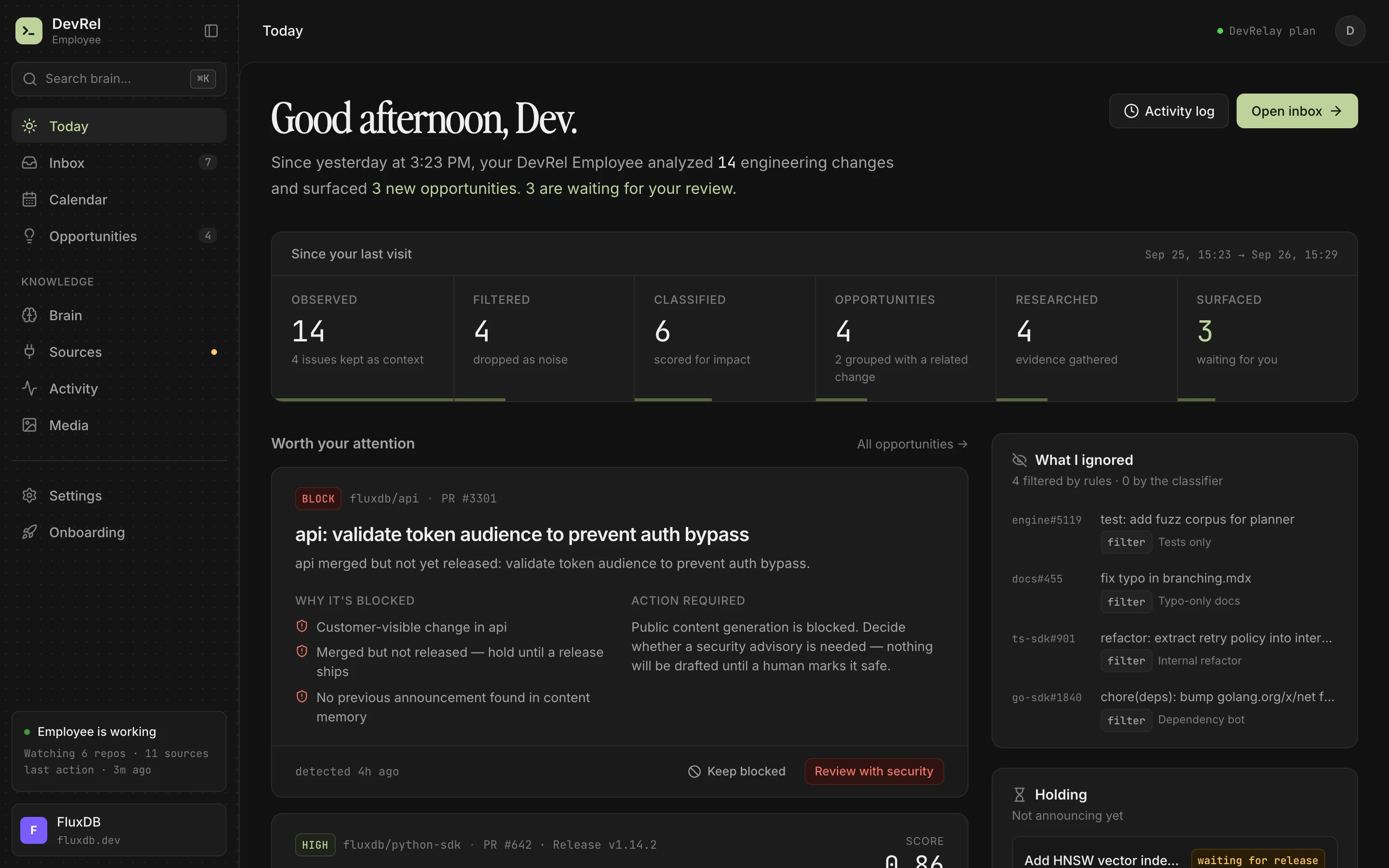
We built DevRelay to run the first three steps of this loop for teams without a DevRel hire. It watches your GitHub, waits for a real release, and decides which changes are worth writing about and where. Then it drafts the changelog entry, the X and LinkedIn posts and a docs update when your docs don't cover the change yet.
It holds merged-but-unreleased changes, sends security-sensitive ones to a person instead of drafting, checks every claim against the diff, and publishes nothing until you approve it. Your part of the loop becomes a review in the inbox, plus the listening, which should stay human.
Frequently asked questions
What does developer relations do at a startup?
It makes sure the developers who would care about each release find out about it, understand it and can use it: announcements, docs and examples, and listening to feedback and passing it to the product team.
When should a startup hire a developer advocate?
When releases outpace the person running DevRel part-time, when the community needs daily attention, or when you want to add talks, sample apps and partnerships on top of a release loop that already runs smoothly.
Who should own DevRel before there's a dedicated hire?
Usually a founder or a senior engineer, with a fixed weekly slot. What matters is that each step has an owner and a time, so it doesn't depend on someone remembering.